

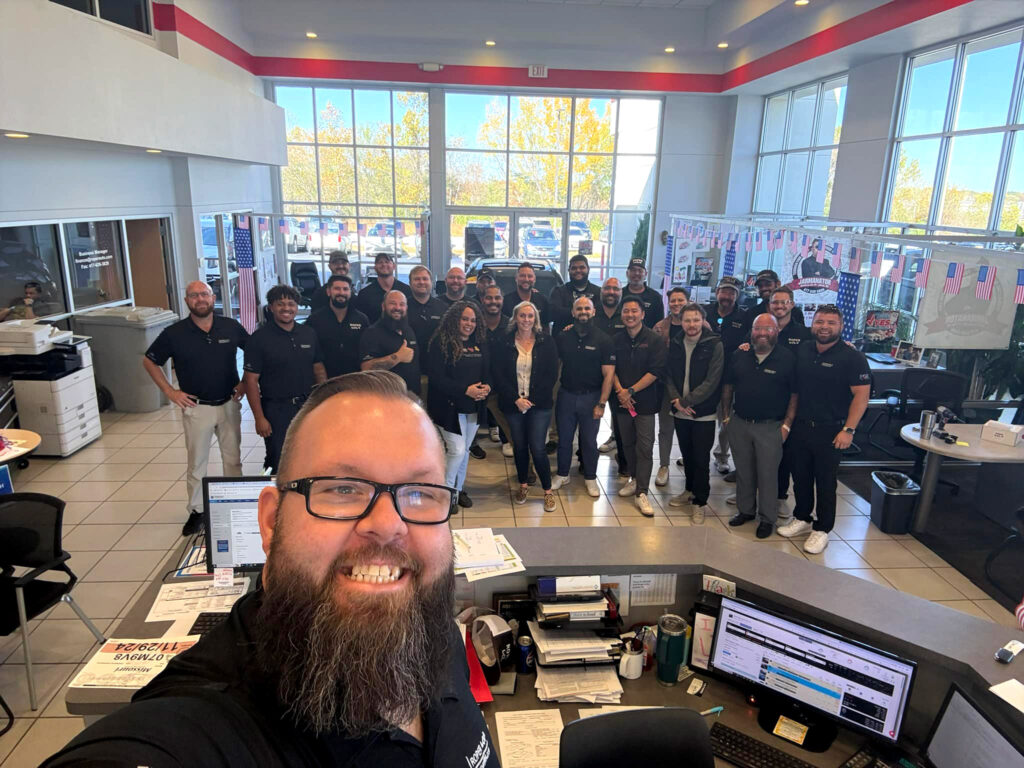
By the time you meet Tustin Ulrich, you’ll already feel like you’re running to catch up. He manages a high-volume Kia dealership in southwest Missouri. He oversees a $10 million real estate portfolio. He’s raising four kids. And now he’s teaching other high earners how to turn their tax bills into wealth with his 1% Effect system.
But if you think this story is about hustle culture, you’d be wrong.
“I build people every day. We sell cars as a byproduct of that,” he says. That single line—half mission statement, half philosophy—explains a lot about how he approaches his work.
Tustin’s journey began at the very dealership he now runs, starting at the bottom in the call center back in 2005. He learned the ropes the hard way—long hours, deals that fell through, relentless sales targets—but somewhere along the line, he realized that selling cars alone wasn’t enough.
“The car business can be unhealthy,” he says. “Unhealthy for your body, your marriage, your mindset. I used to weigh 460 pounds. I was burned out, running on fumes.”
Five years ago, he flipped the script. Gratitude journaling. Leadership training. Health goals. The result? He’s down 160 pounds. His marriage of 20 years is stronger than ever. His dealership doubles the sales volume of competitors, despite not being the “big truck” store in town.
The pivot wasn’t just personal—it was fiscal.
Tax Bills and Time Audits
In 2020, Tustin wrote his first “big” check to the IRS. “I told myself, never again.” He had already been exploring real estate, but that tax bill lit a fire. He and a business partner put together a plan to buy land for storage units, but procrastination cost them the deal.
That disappointment became a door. Within minutes, he heard about an older landlord ready to retire. Tustin jumped. Six duplexes became his first real estate acquisition. Four years later, he controls 53 properties worth $10 million.
And he’s just getting started.
“The wealthy stay wealthy by using the tax code and by using leverage,” he says. “We’ve done $10 million in four years. I don’t see any reason why I can’t get to $100 million by 50.”
He’s 39 now, and his real estate portfolio is booming—but the growth came with chaos. Four businesses, multiple bank accounts, and the daily demands of a dealership were piling up, and the constant juggling left him stretched thin.
That’s when Scott Colonna entered the picture. Last spring, at a mastermind hosted by mentor Danelle Delgado, Tustin met the Florida-based entrepreneur and investor. What grabbed him wasn’t the résumé—it was the calm.
“Here’s a guy with huge businesses, and yet for three days, he wasn’t on his phone once. Not one call, not one step out. That told me something. He’d mastered his time.”
Scott gave Tustin a simple assignment: document every 15 minutes of his day for two weeks. At the end of each day, compare the tasks against your “hourly worth.” If the task was far below his value, it got flagged for delegation.
“I realized how much money I was costing myself doing tasks someone else could handle. Checking deposits, verifying rent rolls—important, yes. But not $500-an-hour work.”
The results were humbling. “I realized how much money I was costing myself doing tasks someone else could handle. Checking deposits, verifying rent rolls—important, yes. But not $500-an-hour work.”
Within a month, he hired his first personal assistant. “It’s been life changing,” he says. “It’s freeing to realize what I actually need to do versus what I just need visibility on. I don’t need to be the one checking every rent payment. I need to be solving bigger problems. And now I have the flexibility to do that.”
While he’s still managing the Kia dealership and building his real estate portfolio, Tustin’s next play is teaching others how to use tax strategy to build wealth, a program he calls the 1% Effect. High earners—physicians, business owners, executives—are drawn to his system because it’s practical: instead of sending six figures to the IRS, buy assets, depreciate them, and watch wealth multiply.
“We just secured 35 new-build homes in Joplin as a package deal,” he says. “We arranged the financing, did the acquisition, property-manage the portfolio, and now we’re teaching the investors how to do a 1031 exchange to turn one property into four over ten years. No extra money out of pocket, and tax free!”
This is the 1% Effect in action: small, consistent moves that compound into generational wealth. It’s also a reflection of Tustin himself—playing the long game, betting on patience over quick hits.
Looking Ahead
Where does it all lead? Tustin’s answer is refreshingly unslick.
“I love automotive because I love people. That’ll always be part of my life. But now that I understand real estate, I can’t unsee it. It’s generational wealth. It’s giving my kids a launching pad I didn’t have.”
In December, his dealership is gunning for a sales goal that, if hit, will allow him to close the store for a week between Christmas and New Year’s—a radical move in car sales. At the same time, he’s planning to double his real estate holdings in the next two years.
But the real milestone? He and his wife headed to Maui for their 20th anniversary, renewing their vows at sunrise on the volcano that formed the island.
“We came from nothing,” he says. “She was raised in the front of a barn. My parents were addicts. We didn’t think we’d ever be living this life. Gratitude is what got us here. And gratitude plus an unwavering faith in our creator will get us the rest of the way.”
4 Business Lessons Any Entrepreneur Can Use
Audit Your Time Ruthlessly: Track your days in 15-minute increments for two weeks. You’ll quickly see what you’re doing that someone else could handle. Protect your highest-value hours and delegate the rest.
Start Small, Then Scale: Tustin’s first real estate buy was six duplexes. It wasn’t $9 million—it was a foothold. Start where you are, with what you can afford. Growth compounds.
Learn from the Missed Deals: The storage unit project that slipped away taught Tustin to move faster on the next opportunity. Every miss is tuition for the next win.
Build People, Not Just Profit: Tustin’s dealership thrives because he invests in people first. Culture and leadership aren’t soft skills—they’re multipliers for every bottom line.
Rachel and Scott suggest that as Tustin’s empire grows, he needs to make sure systems grow with it. Processes, people, and guardrails are what protect both wealth and sanity at scale. Growth without structure risks burnout—the very thing so many work so hard to escape.